The UD Classics department was founded by Father Placid Csizmazia, a Cistercian priest from Hungary, who was educated in Classics at the Royal University of Budapest before World War II. In childhood he had been an astonishing student, who never once in any subject, from the first grade through college, got any gra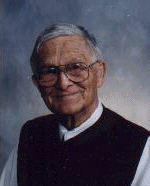 de but A; and his Ph.D. thesis, on the language of Pope Leo the Great’s sermons, was judged the best of its year, although the German invasion of Hungary prevented the prize from being awarded. By then he had already a thorough grounding in classical languages and an intimate knowledge of the Christian Greek and Latin writers, to an extent unparalleled today.
Father Placid was a brilliant linguist; he was eventually fluent in 11 languages, and at the time of his death in 1999 was learning a twelfth, Hebrew. This talent enabled him, after the German defeat, to teach for many years even under the Communist regime, that had now seized power in Hungary. Though forbidden to live as a priest, he was one of the few Cistercians still allowed to teach, because he knew Russian. The bureaucrats who hired him did not realize that he had only recently got an introductory textbook of Russian and had taught himself the rudiments of the language in a few weeks!
In 1966 Father Placid came to the Abbey of Our Lady of Dallas, and began practicing his English while teaching Greek to his first UD students, who included Professors Donald and Louise Cowan and then-undergraduate Alexandra Wilhelmsen. It soon became clear to everyone how valuable a knowledge of the classical languages was to the study of the ancient, medieval, and early modern texts which a recent reform had placed at the heart of UD’s new Core Curriculum. The aim of this reform was nothing less than the recovery of the western tradition of liberal learning for every single undergraduate here. With advice from the Cowans and Sybil Novinski, Father Placid mapped out a Classics major that amply supported the “humanities” side of the Core through advanced language courses in Greek and Roman epic, drama, philosophy, and history, and through other courses in Latin and Greek writers from the Christian era.
He was also a kind, affectionate, and good man, who was truly mourned by many people when he died on October 30th, 1999. One of his U.D. students has described him thus (Javan Kienzle, Judged By Love, Kansas City, 2004, p. 207-8. The author was 40 years old at the time she describes):
Father Placid Czismazia (he told me that the name meant bootmaker in Hungarian) was a wizened little man with a personality that matched his given name, and a face that was so lined that when he smiled–which was often–he looked like a happy raisin. He also was the quintessential teacher.
Seventeen undergrads and I made up his Greek class. I cannot fully describe the attentiveness with which we listened to him. He taught us not only the Greek language, but also Greek history and culture, as well as the relevant biblical connections. When the bell rang ending class, no one wanted to leave; we sat enthralled, assimilating what we had just heard.
( . . . ) But I will never forget Father Placid. He and I corresponded after [the Greek course was over]. Several times a year I would receive a long letter from him, written in pen and ink in his beautiful hand, telling me about his trips, his projects, his family. His letters were gems of history, culture, religion, and politics. Frequently, he enclosed photos.Eventually, he was able to travel to Hungary to be reunited with students he had taught fifty years before, students who now had families of their own, to whom they introduced their beloved Father Placid.
We continued to correspond until his death a few years back. I felt blessed to have known him. I wish that all students could have a Father Placid in their life.
* * *
In its present form, worthily, we hope, of Father Placid, the study of classics at UD differs a bit from that at most universities. First, rather than being a rather arcane specialty as it is elsewhere, Classics at U.D. has a special prestige from the fact that over a third of the Core texts, studied in translation by all U.D. students, are from Greek or Latin originals; and most other Core texts were written by authors steeped in the classics. For example, in the freshman English courses ‘Literary Tradition’ I and II, all U.D. freshmen study the Iliad, the Odyssey, the Aeneid, and then their modern imitations, Paradise Lost and the Divine Comedy; but only Classics students can have the joy of studying Latin and Greek just as Milton and Dante did, and of reading the prodigiously beautiful originals.
This is true of many other Core courses. And from this fact that so many ancient texts are taught in translation by other departments, in Core courses that all students take, U.D. Classics students get several other special rewards. The first is that of this or that ancient work they often get an abnormally sharp, stereoscopic vision; for they study it not only with us in Classics but also with their English or Politics or Philosophy teachers, who also love it and may have a different ‘take’ on it. The second is that we in Classics, free of the heavy burden of teaching texts in translation, are free to concentrate on the originals; and this enables us to do it with a special rigor. For both forms of the Classics major, ‘Classics’ and ‘Classical Philology’, knowledge of both Greek and Latin are mandatory, and all of a student’s major courses can be, and usually are, in Greek and Latin texts read in the original.
This means, in effect, that all UD classics majors make an especially close study of language itself, of its very architecture. This fact alone can bring a deep quiet joy; for all our lives, no matter what our work, language itself–which in our case means English, deepened and sharpened by knowledge of its two most illustrious ancient ancestors–is actually the lens, stereoscopic and finely adjustable, through which we perceive reality.
Of course this work of constant daily translating is specially hard. A Classics major soon discovers that Greek and Latin are but faint footprints, left by the voices of extinct peoples, and that we are tone-deaf, and at first often just half understand them. Later comes another problem: the more we do understand the bold, subtle Greek of Thucydides or Pindar, or the astonishing Latin of Vergil or Tacitus, the more we see how truly untranslatable it is, because of its density and its gigantic beauty. But to live alone with that secret is itself a happiness.